Market Pulse

Market Pulse
Why Enterprises Need Scanners to Find Their Own Agents

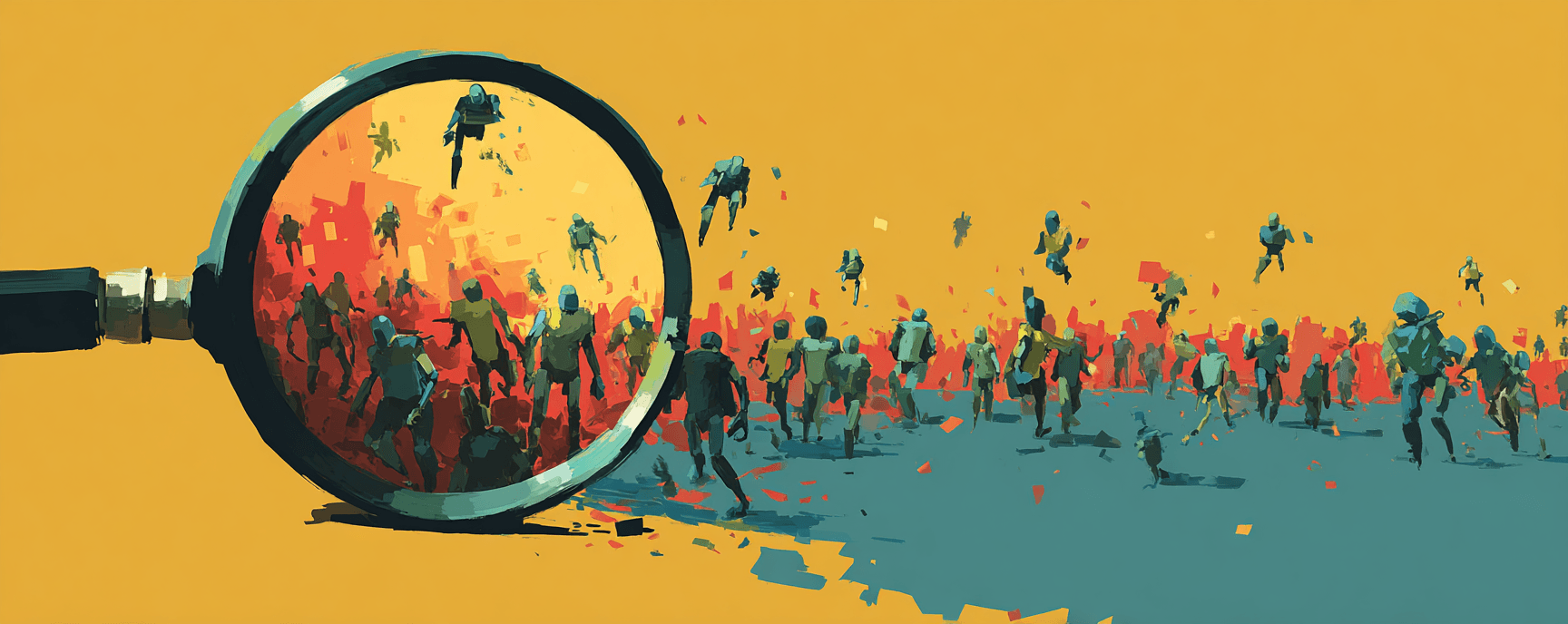
MuleSoft launched Agent Scanners in January 2026 to help enterprises answer what should be straightforward: what agents do we have running in production? When you need dedicated scanning tools just to see what you've deployed, the deployment wave has outpaced operational visibility.
While 79% of enterprises report adopting AI agents, only 23% are actively scaling them. Salesforce predicts hundreds of agents per employee in 2026, most sitting idle—"impressive but invisible." The gap between deployment capability and actual utilization isn't about adoption resistance or change management. It's about something more fundamental: whether deployed agents can be found by the people who need them.
Why Enterprises Need Scanners to Find Their Own Agents
MuleSoft launched Agent Scanners in January 2026 to help enterprises answer what should be straightforward: what agents do we have running in production? When you need dedicated scanning tools just to see what you've deployed, the deployment wave has outpaced operational visibility.
While 79% of enterprises report adopting AI agents, only 23% are actively scaling them. Salesforce predicts hundreds of agents per employee in 2026, most sitting idle—"impressive but invisible." The gap between deployment capability and actual utilization isn't about adoption resistance or change management. It's about something more fundamental: whether deployed agents can be found by the people who need them.
Where This Goes
Organizations deploying agent systems keep hitting the same wall. Not technical limits. Not model capabilities. They can't figure out who owns the work when something breaks overnight.
The pattern shows up across enterprise deployments: agents handling web automation at scale fail in ways that look like workforce capacity problems, not software bugs. A session timing out isn't a ticket for engineering. It's a business process that stopped running. Someone needs to notice, diagnose, restart, and explain the gap to whoever was waiting on that output.
Most teams assume this is an infrastructure problem they'll solve with better reliability. Our read from operating thousands of concurrent web sessions: the infrastructure works fine. The org chart doesn't. Companies are deploying agents faster than they're defining who manages them when the work fails.
From the Labs
What Production Agent Systems Actually Look Like
Research prototypes chase complexity while production systems prove simple, controllable approaches already deliver measurable impact.
Human oversight and straightforward architectures, not elaborate coordination schemes, power agents across 26 industries today.
From the Labs
When Multi-Agent Coordination Helps Versus Hurts Performance
A quantifiable model lets architects choose coordination patterns based on measurable task characteristics, not intuition.
Parallelizable work improves 80.8% with centralized coordination, but sequential reasoning consistently degrades across all multi-agent variants.
From the Labs
Systematic Framework for Diagnosing Agent System Failures
Test-driven development assumes determinism, but probabilistic components demand fundamentally different diagnostic approaches for production systems.
Linking behavioral signals to specific components transforms failure detection into actual diagnosis of root causes.
From the Labs
Engineering Lifecycle for Production-Grade Agent Workflows
Governance, observability, and operational reliability that enterprises require before deploying agents at scale.
Single-responsibility agents and deterministic orchestration provide concrete patterns for tackling operational challenges systematically.