

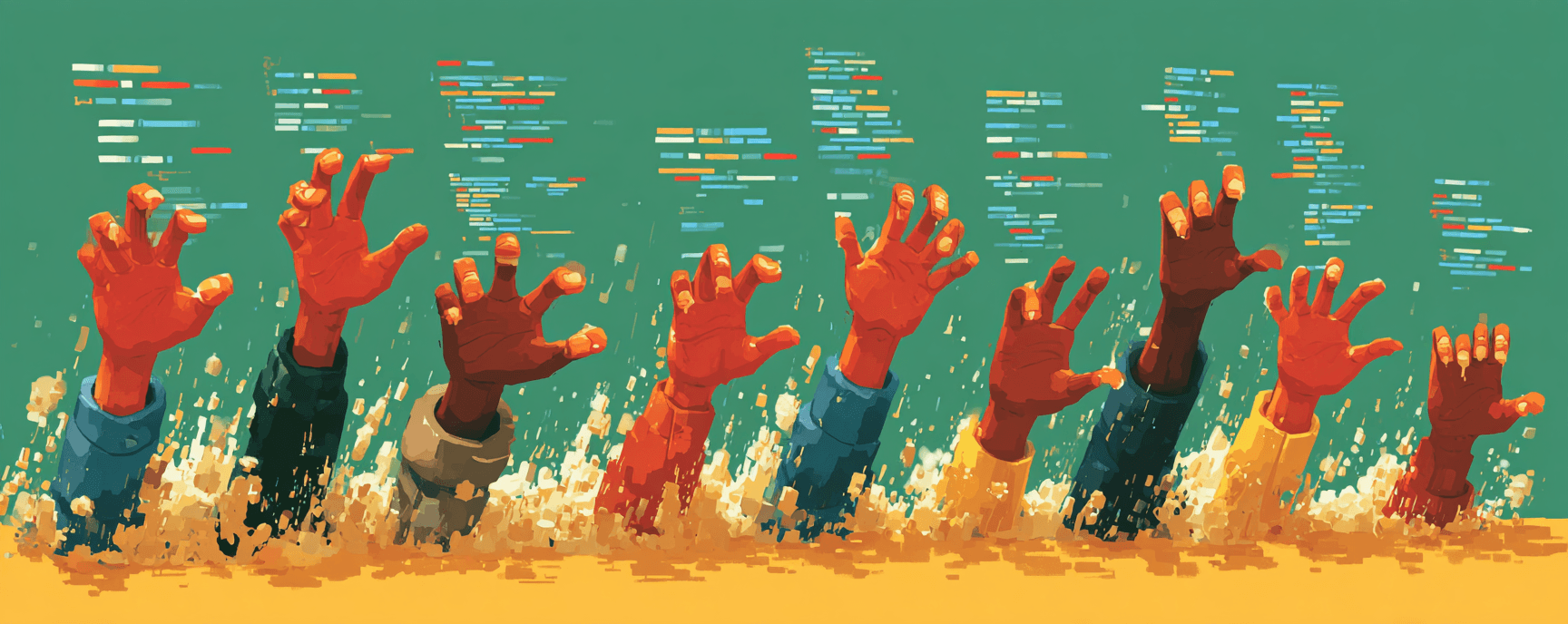
The engineer's fingers hover over the keyboard. Muscle memory fires—the syntax patterns, the familiar keystrokes, years of practice encoded in motion. But something's wrong. The act of typing code manually now triggers a wave of irritation so visceral it's almost physical. The skill remains intact. The tolerance for using it manually has collapsed.
That frustration surfaced in late 2025 when a software engineer realized:
"Typing out code by hand now frustrates me."
Expertise that once defined professional identity had become friction. The capability stayed. The willingness to use it manually disappeared.
Work that shaped your professional identity now triggers active resistance. Teams can't function the way they used to. The shift stays personal for a while. Then everyone's hands remember but their brains refuse, and organizational structure starts bending under the pressure.
The Structural Pressure
When Brandon Clark at Digital Trends Media Group reached the point where he could tell his AI system "any time it writes a new feature, make sure to also write tests for it. And while you're at it, run the tests, and if anything breaks, fix it," he was creating a gap between his output capacity and the team structure designed around slower execution.
Organizations responded. 64% altered their entry-level hiring approach as execution-heavy roles compress. The transformation shows up in how work gets allocated as execution speed loses its constraining force.
Teams need capabilities they didn't need before: identifying which decision points actually require human judgment, designing escalation paths that work under time pressure, maintaining accountability for work that flows through people rather than from them.
Nearly 45% of AI-generated code contains security flaws. Subtle errors compound when output moves through multiple steps or between teams. Professional developers in a 2025 study captured the weight:
"If there is a 0.001 percent chance that this could make mistakes, that is still my name. That is on me if it's wrong."
You're accountable for work you didn't do. That requires capabilities most teams haven't developed yet: knowing which outputs to trust, spotting when the assistant is wrong, understanding what the system doesn't know.
Organizations are building new structures around these capabilities. Human approval gates where AI drafts but humans decide. Progressive oversight where more capable agents receive proportional scrutiny. Sample validation protocols that start intensive and gradually decrease but never reach zero. New organizational infrastructure, in other words.
The Structural Lock-In
Teams reorganize around AI assistance. The old allocation of work stops making sense. Workers with advanced AI skills earn 56% more than peers in the same roles without them. "Advanced AI skills" describes judgment, oversight, directing systems of work. Capabilities that reshape reporting relationships and decision rights.
Organizations that successfully navigate this threshold are forming new roles around oversight and judgment rather than execution. Career growth now centers on expanding responsibility rather than climbing titles. The professionals who remain valuable are those who can evaluate output they didn't create and maintain accountability for work that flows through them.
Reversing these structural changes means unwinding organizational capacity. Teams would need to rebuild workflows around slower execution. Managers would need to reallocate work based on typing speed rather than judgment quality. That visceral irritation with manual execution marks the point where your team's structure has fundamentally shifted. Your hands may remember how to do the work manually, but your organization increasingly can't afford for you to.
Things to follow up on...
-
Evaluation as discipline: Agent evaluation is rapidly becoming its own field with new tools and metrics emerging specifically for autonomous systems that don't fit traditional testing methods.
-
The wage premium: Skill change is accelerating fastest in the most automatable jobs, up from 25% last year to current levels, creating new compensation dynamics.
-
Training stage organizations: About 21% of organizations report being in the training stage focused on developing employee training for AI oversight, while 61% have already integrated Responsible AI into core operations.
-
Career growth patterns: Career advancement is becoming less linear as professionals advance by expanding responsibility rather than climbing titles, with execution-heavy roles shrinking fastest.