
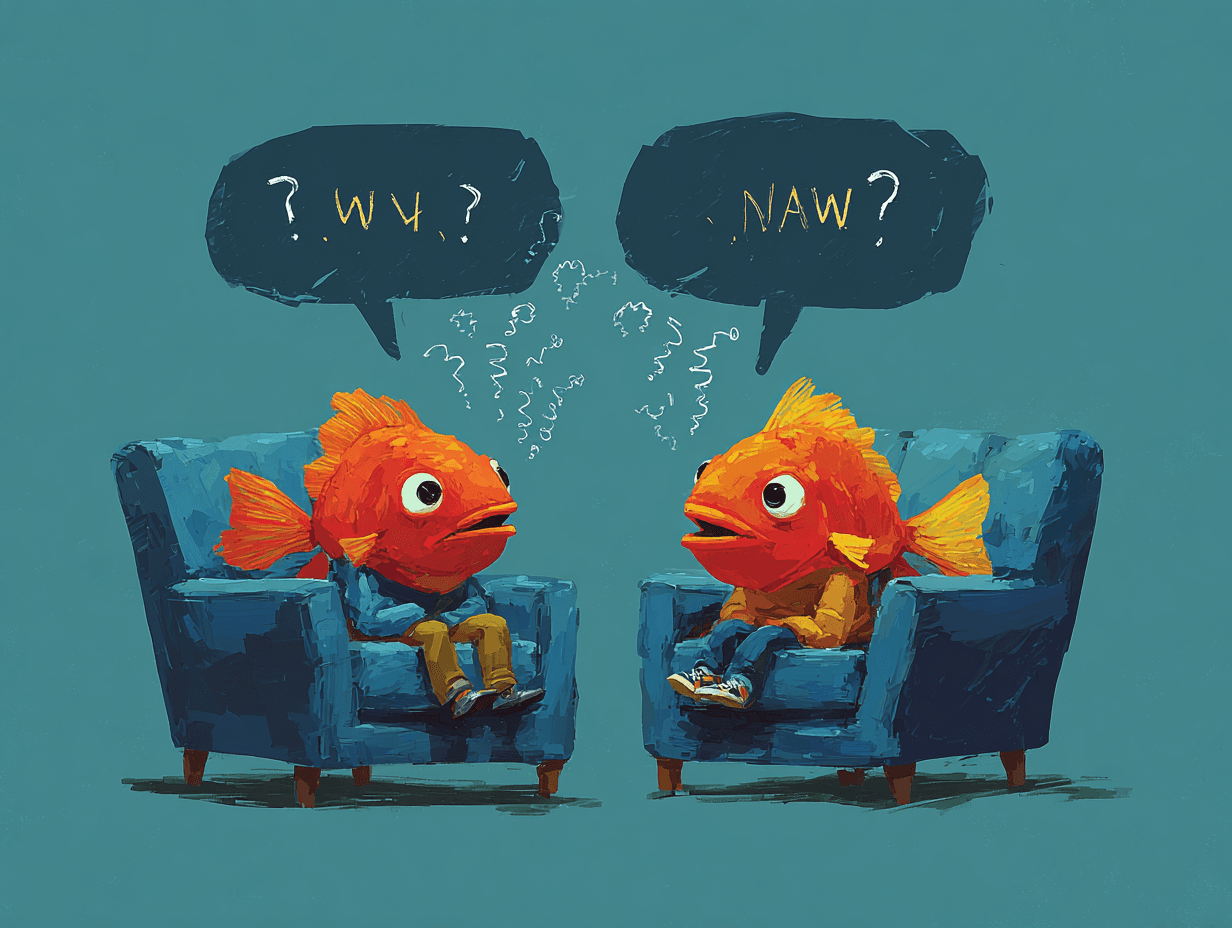
Margot Vellum is not a real person, though she is, regrettably, a composite of several real conversations that all ended with someone staring into a glass of wine and saying some version of "I don't know what I'm for anymore." She is the VP of Marketing at a mid-size cybersecurity SaaS company, a former tech journalist who crossed into content marketing fifteen years ago and built a career on the conviction that good writing wins deals. We spoke over video. She had a mug that read "Content Is King" with "King" crossed out in Sharpie and replaced with nothing.
Gartner's forecast that 90% of B2B purchases will be handled by AI agents within three years has become the kind of statistic that shows up in every conference keynote, every board deck, every anxious Slack thread in every marketing department.1 The $15 trillion number floats around like weather. But statistics describe a shift. They don't describe what it feels like to be standing in the path of one.
For Margot Vellum, the shift arrived as a polite email from the procurement team at her third-largest customer. Their AI agent had already shortlisted three vendors before anyone on the buying committee read a single piece of content her team produced.
When did you first feel the ground move?
Margot: Last April. We lost a renewal we shouldn't have lost. Not on product, on discovery. The customer's procurement system had re-evaluated vendors automatically, and we weren't in the initial shortlist. We found out after the fact. My head of demand gen called me and said, "They didn't even see us," and I thought she meant the email got filtered. She meant the agent didn't surface us.
Completely different problem.
What's the difference, mechanically?
Margot: When a human buyer researches vendors, they browse. They read your blog, maybe. They see your booth at RSA. They ask a colleague who asks another colleague who vaguely remembers a podcast episode. There's this whole messy, emotional, nonlinear process, and content marketing was designed to be present in that mess. You write the article that shows up when someone's Googling at 11 PM. You sponsor the podcast they listen to on the treadmill. You live in the ambient awareness.
An agent doesn't have ambient awareness. It has retrieval logic. It pings APIs, checks structured data — pricing, integrations, compliance certifications — and returns three to five options.2 Not ten. Not a ranked page. Three to five. If you're not in that set, you don't exist. There is no page two. There's no "oh, I remember seeing their name somewhere." You're in the shortlist or you're in the void.
That sounds like SEO on steroids.
Margot: Structurally different. SEO was about ranking. You could be position seven and still get clicks. You could be on page two and someone persistent would find you. This is more like... remember how in the old days, a buyer would call three vendors for quotes? It's that, except the buyer's AI is making the calls, and it's calling based on structured data and third-party citation patterns, not on whether your CMO gave a great talk at SaaStr.3
So what happens to the great talk at SaaStr?
Margot: It becomes a luxury good. Still matters for deals above a certain size — the million-dollar-plus range where someone wants to look across a table and take your measure.4 But that band is shrinking. And even there, the agent has already done the shortlisting. You're not persuading anymore. You're confirming a decision that was mostly made by a machine.
What does your team look like now versus two years ago?
Margot: Two years ago I had twelve people producing content. Blog posts, white papers, case studies, webinar scripts. Good stuff. Stuff I was proud of. Now the volume work is essentially automated, and half my team is doing what I've started calling "authority engineering" — a term I made up because I needed something to put on a job description. It means making sure that when an AI system gets asked about endpoint security for mid-market companies, we show up in the citations. Not our website. What third parties say about us. What analysts write. Whether we're in the publications these systems actually index.5
That sounds like PR.
Margot: It is PR! PR with a different measurement layer. Muck Rack found that 82% of links cited by AI systems come from earned media.6 So suddenly my most important channel isn't the blog I spent a decade building. It's whether other people are writing about us in places AI trusts. And recency matters enormously — half the citations come from the last twelve months. So it's not just earned media, it's continuous earned media. A treadmill that resets every quarter.
You sound like you're adapting. So what's the actual crisis?
Margot: (long pause)
The crisis is that I'm good at something that doesn't matter the way it used to. I can write a piece that makes a CISO feel something. I can tell a story about a breach that makes a room go quiet. I spent fifteen years learning how to move people with language. And the thing making the purchasing decision now doesn't feel. It retrieves.
I'm not saying the skills are worthless. They matter in that narrow band at the top. The keynote, the executive dinner, the deal that's big enough to still require a handshake. But that's not a marketing strategy. That's a residue of one.
Do you think the craft survives in some form?
Margot: I think the craft survives the way calligraphy survived the printing press. It becomes a signal of taste, not a means of communication.
The actual work — the work that drives pipeline — is becoming infrastructure. Structured data. API readiness. Citation engineering. Important work. Just not my work. Or it wasn't. I'm learning to make it mine. But some mornings I open a spreadsheet of citation metrics and I think, this is not what I imagined when I left journalism.
What would you tell a content marketer five years into their career right now?
Margot: Learn to read a schema. I'm serious. Learn what structured data looks like. Learn how AI systems retrieve and rank. And then — this is the part that sounds contradictory — also become genuinely, irreplaceably expert in something. Because the one thing AI can't cite is an insight that doesn't exist yet.7 Commentary is cheap. Authority means people can't understand the topic without you. That's still human.
For now.
For now.
Margot: Yeah. For now.
Footnotes
-
Gartner IT Symposium/Xpo 2025, reported by Digital Commerce 360, December 9, 2025. https://www.digitalcommerce360.com/2025/11/28/gartner-ai-agents-15-trillion-in-b2b-purchases-by-2028/ ↩
-
McKinsey analysis of agentic commerce, January 2026, as cited in AuthorityTech.io, February 28, 2026. https://authoritytech.io/blog/how-ai-agents-discover-b2b-vendors-2026 ↩
-
Kearney research on AI agents in B2B buying, reported by Distribution Strategy Group, October 13, 2025. https://distributionstrategy.com/ai-agents-are-reshaping-b2b-buying-forcing-distributors-to-rethink-digital-strategy/ ↩
-
Forrester research on human validation in B2B buying, cited in Catalist Group, February 13, 2026. https://catalistgroup.co/ai-in-b2b-distribution/ ↩
-
Microsoft's February 2026 launch of AI Performance reporting in Bing Webmaster Tools introduced citation count as a primary metric for content visibility in AI-generated answers, as reported in AuthorityTech.io, February 28, 2026. https://authoritytech.io/blog/how-ai-agents-discover-b2b-vendors-2026 ↩
-
Muck Rack Generative Pulse study, December 2025, covering over one million AI responses. Cited in AuthorityTech.io, February 28, 2026. https://authoritytech.io/blog/how-ai-agents-discover-b2b-vendors-2026 ↩
-
IdeaGrove, "Why Thought Leadership Is Broken (And How AI Finally Exposed It)," February 16, 2026. https://www.ideagrove.com/blog/why-thought-leadership-is-broken-and-how-ai-finally-exposed-it ↩