Vision
Vision
The Consequences Nobody Designed For

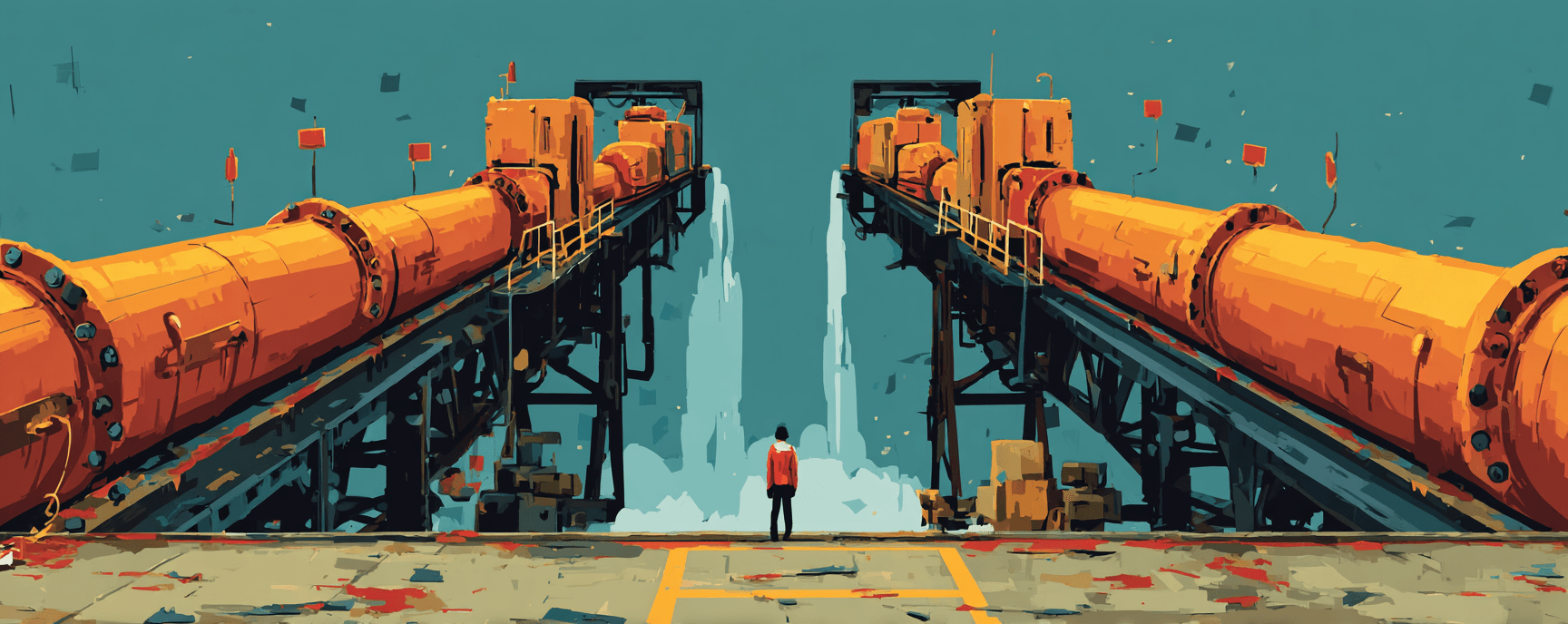
In the fall of 1913, Ford's engineers divided chassis assembly into 45 separate operations and watched throughput soar. They hadn't even settled on a name for what they'd built. What they also hadn't anticipated: a set of consequences that would take decades to fully surface. What happens to craft, to quality, to accountability itself when no single person can see the finished product?
Multi-agent AI is now decomposing knowledge work along that same logic. The efficiency gains are loud. The organizational shifts are quieter, slower, and already underway. A recent controlled trial of experienced developers hints at the most unsettling part: the consequence the system gives you no reason to suspect.
The Consequences Nobody Designed For
In the fall of 1913, Ford's engineers divided chassis assembly into 45 separate operations and watched throughput soar. They hadn't even settled on a name for what they'd built. What they also hadn't anticipated: a set of consequences that would take decades to fully surface. What happens to craft, to quality, to accountability itself when no single person can see the finished product?
Multi-agent AI is now decomposing knowledge work along that same logic. The efficiency gains are loud. The organizational shifts are quieter, slower, and already underway. A recent controlled trial of experienced developers hints at the most unsettling part: the consequence the system gives you no reason to suspect.
Two Implications

The Foreman Problem
Engineers at top companies have stopped writing code. Their new job is supervising agents that write it for them, a role that borrows from people management, tool configuration, and air traffic control without mapping cleanly to any of them. We've spent centuries building institutional scaffolding for managing humans. For governing entities you own but don't fully control, we have almost nothing. The role doesn't even have a name yet. It probably needs one.

How to Divide What You Haven't Done
Before you can supervise an agent team, someone has to decide how to split the work. This decomposition — scoping tasks so autonomous agents don't collide, duplicate, or silently corrupt each other's output — is the invisible skill that separates spectacular multi-agent performance from spectacular multi-agent failure. It demands deep familiarity with the work being divided. And agents are starting to make that familiarity unnecessary.

The Speed Signal
Multi-agent architectures on the Databricks platform grew 327% in under four months. The dominant pattern: a supervisor agent breaking goals into sub-tasks for specialized workers. Organizations already knew how to decompose knowledge work. They were just waiting for the primitive.
That speed is remarkable. It also maps onto exactly the phase of industrial assembly-line adoption when the harder consequences started compounding. Taylor's decomposition boosted productivity immediately. Deskilling, quality erosion, management bloat arrived on the same timeline, just less visibly.
The honest read is that both things are true simultaneously. The ease of decomposition reveals something real about knowledge work's modularity. And the history of decomposition suggests the system-level costs are accumulating somewhere we haven't learned to look yet.
Further Reading