
Echoes

Echoes
What the Form Carried

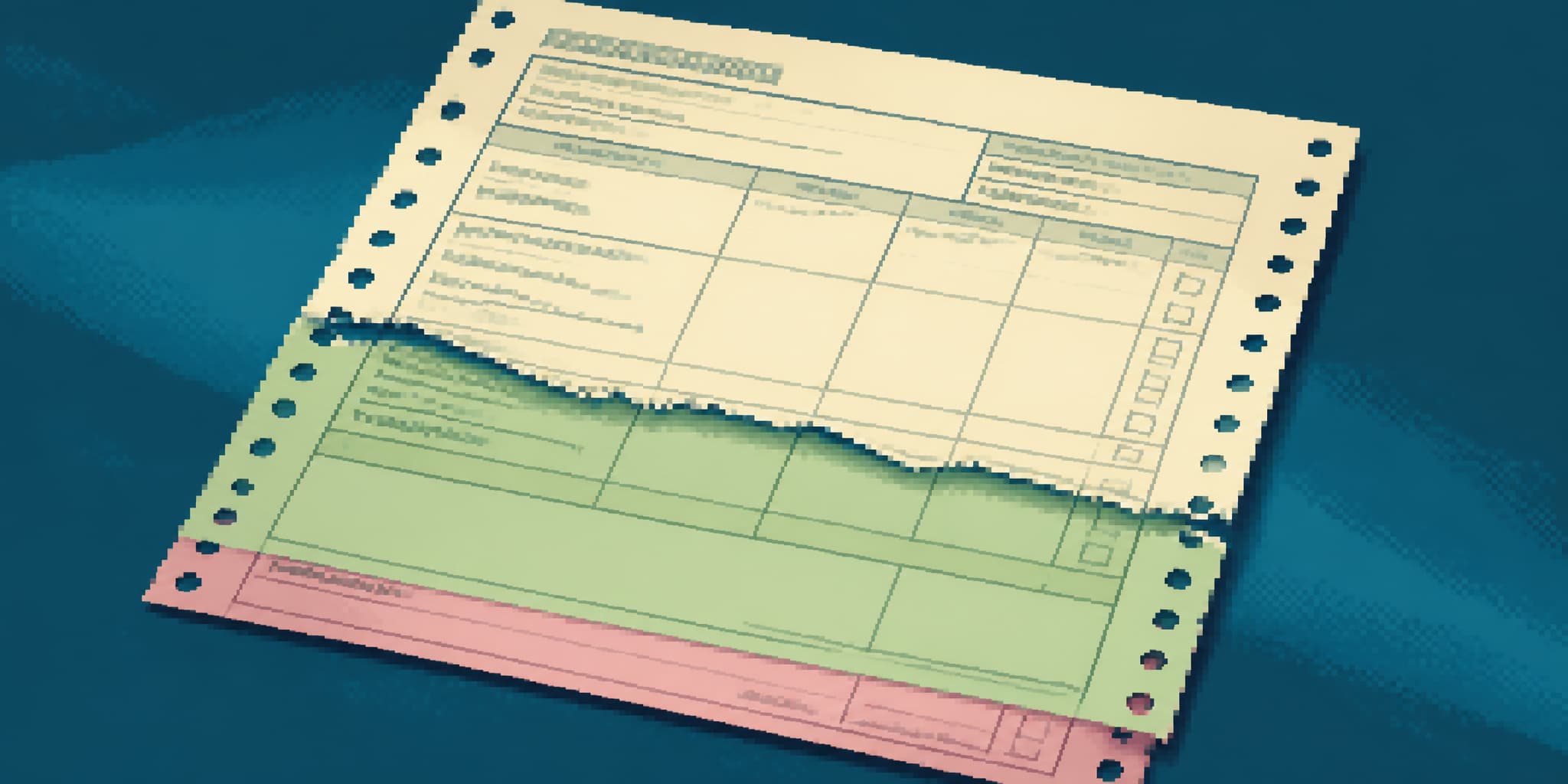
A U.S. military pocket purchase order once had four color-coded carbon copies. White went to finance. Blue went to the vendor. Pink served as the receiving and accounting record. Green stayed with the purchaser. Tear along the perforation and the institutional workflow was already in motion — the object was the process. When HTML formalized the <form> element in 1995, it reproduced the data-collection surface with real precision: name/value pairs, a destination URI, a method. Everything else was left out of scope. No authority. No routing. No accountability structure. Automated agents now fill out what remains.
What the Form Carried
A U.S. military pocket purchase order once had four color-coded carbon copies. White went to finance. Blue went to the vendor. Pink served as the receiving and accounting record. Green stayed with the purchaser. Tear along the perforation and the institutional workflow was already in motion — the object was the process. When HTML formalized the <form> element in 1995, it reproduced the data-collection surface with real precision: name/value pairs, a destination URI, a method. Everything else was left out of scope. No authority. No routing. No accountability structure. Automated agents now fill out what remains.
The Carbon Copy
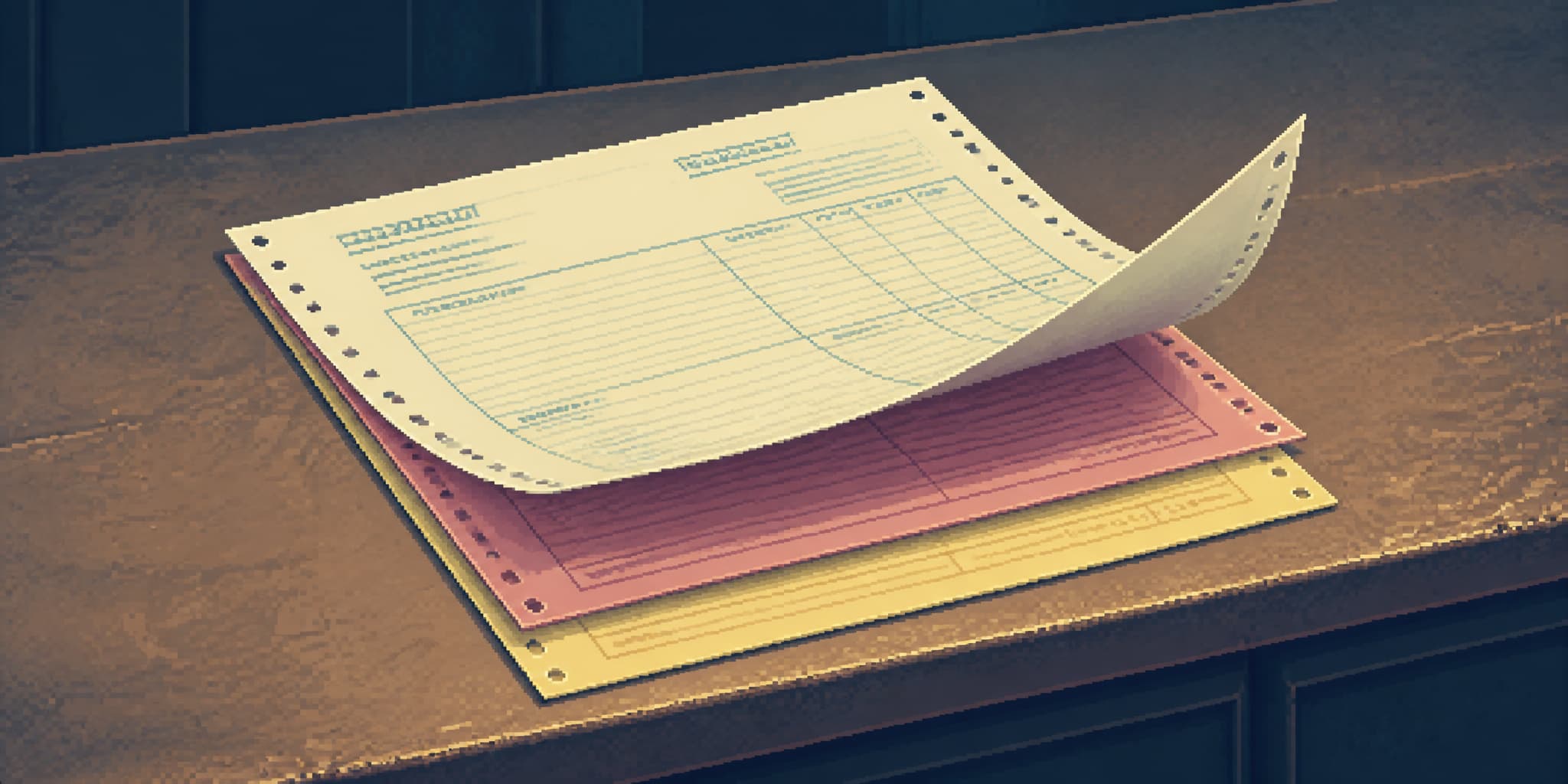
A three-part carbonless invoice created three institutional records the instant a pen touched paper. White to the customer. Yellow to accounting. Pink to the field technician. The colors were routing instructions embedded in the physical structure of the document itself. You could audit the form set at a glance: are all parts present? Who has them? Distribution was something the paper did, not something someone remembered to configure afterward.
The web form replaced this with a database write and, if a developer wired it up, a confirmation email to one party. The agent's equivalent is a log entry designed for debugging a failed session, not for answering the question a stranger might ask years later: who authorized this, and who holds the record?
Every step in this progression was reasonable. And every step quietly turned "who has a copy?" from a property you could read off the document into a question that requires knowing where to look.

An Interview with the Woman Who Designed Systems That Happened to Fit on Paper
CONTINUE READINGRestoring the Furniture

What the Approval Chain Was Holding Together
For decades, enterprise workflow systems painstakingly rebuilt institutional process in software: approval chains, role assignments, audit trails, digital signatures. Each layer reconstructed authority that screens had quietly stripped away. Then bots arrived and navigated those surfaces without inheriting any of the logic underneath. A GSA Inspector General audit showed what that looks like in practice: security plans written for human users that never once mentioned the bots clicking through them.

The Newest Furniture
Visa and Cloudflare, solving different problems in different industries, independently arrived at the same structural move: re-deriving paper-era governance concepts for automated actors. Mandate scope. Purpose classification. Delegation ceilings. A notarized letter from 1950 carried these elements without trying. Now they are being spelled out as API fields and HTTP-layer defaults, because the actors occupying these systems carry less institutional context than any that came before.
Further Reading


Past Articles

A click from an authenticated session used to be enough. Enough to buy, authorize, trigger. The human supplied the inten...

Twenty years of browser automation engineering solved one question with extraordinary precision: did we click the thing?...

Every click on "Place Order" or "I Agree" carries a compressed bundle of assumptions: visibility, intent, authority, acc...

OAuth emerged because giving a photo-printing service your full password was terrifying. By 2020, RFC 8693 had defined a...