

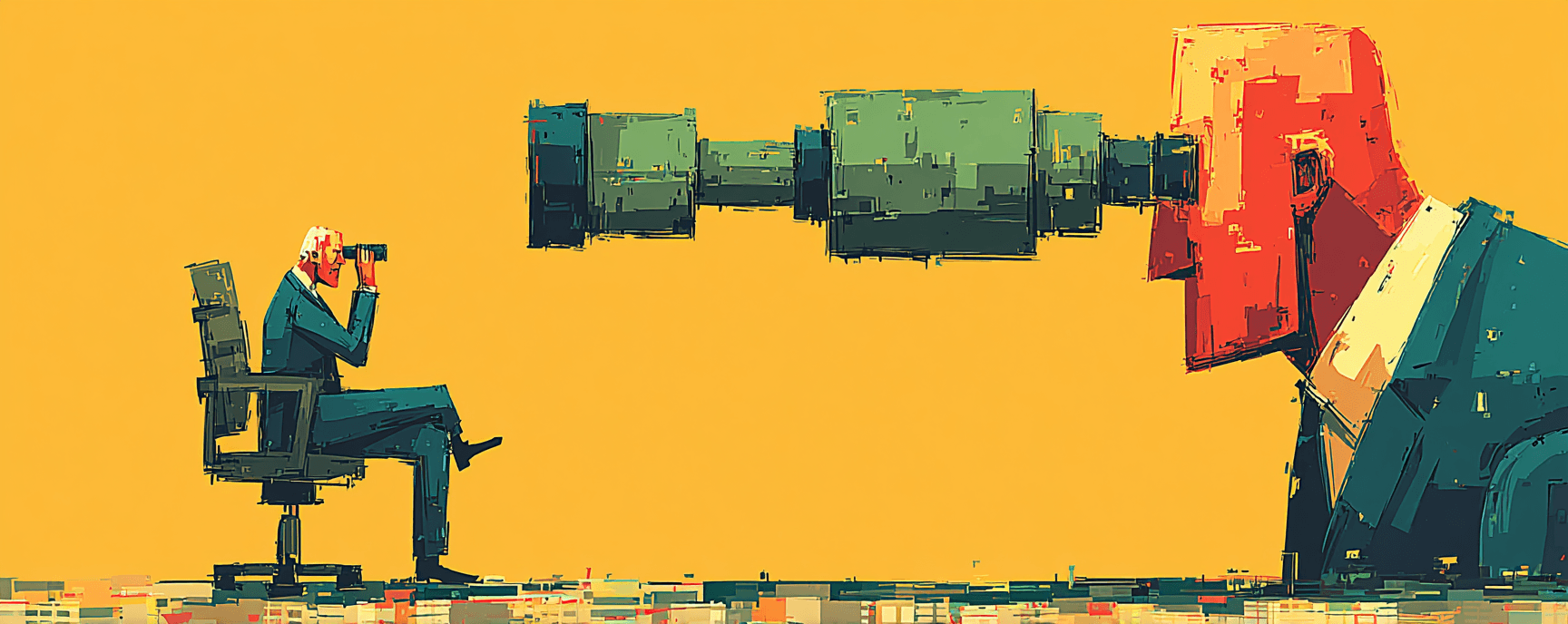
When agents arrive, you stop watching work happen.
With traditional enterprise software, humans remain in the execution loop. You use Salesforce to record customer interactions, Excel to run financial models, Slack to coordinate with teammates. The software augments your actions, but you're still the actor. You see each step. Trust builds through direct observation—if Excel's formula produces an unexpected result, you check the inputs. You're watching.
Web agents break this pattern. When an agent monitors competitor pricing across thousands of sites, it's not just gathering data. It's navigating authentication flows that change without notice, handling bot detection that varies by region, interpreting site structures that A/B test constantly, distinguishing genuine price changes from temporary glitches. Each site presents judgment calls: Is this CAPTCHA challenge worth escalating? Is this price anomaly real or a parsing error? Does this regional variation matter?
You're not in the execution loop for any of this. The agent made hundreds of micro-decisions while you were in meetings.
Your trust must now work differently. You're evaluating aggregate outcomes, not observed actions. Call it what it is: delegation, not cooperation. And organizations keep confusing the two.
What Happens in Production
At TinyFish, we operate web agent infrastructure across thousands of sites simultaneously. The observation gap shows up in specific, recurring patterns. When an agent encounters a website that's added CAPTCHA challenges overnight, or regional pricing that's shifted from the expected range, or compliance documentation in an unexpected format—these are judgment calls that happen in real-time, during execution. The customer isn't watching. They learn about the agent's decision through the output: either the data arrived with appropriate confidence flags, or it didn't.
What production teaches: the observation gap isn't abstract. It's the moment when a site structure changes and the agent must decide whether to retry with adjusted parameters or flag for human review. It's when pricing data seems anomalous and the system must determine if it's a genuine market shift or a scraping error. These micro-decisions happen thousands of times across a fleet—and customers need frameworks for evaluating whether the system's judgment patterns merit continued delegation.
The web's adversarial nature makes this particularly acute. Unlike database automation or internal workflow tools, web agents operate in an environment actively resisting automation—bot detection, rate limits, personalization that shows different data to different users. The observation gap compounds because you're not just trusting the agent's judgment; you're trusting its ability to navigate an environment designed to block it.
Cooperation vs. Delegation
Cooperation means human and system work together on each task. The human initiates actions, observes results, maintains continuous feedback. Trust builds naturally through observation.
Delegation means the system operates autonomously while humans oversee outcomes. You're not watching the work happen—you're evaluating whether the system as a whole merits continued delegation.
The distinction matters because it changes how you evaluate readiness. Before committing to agent infrastructure, the question isn't "Can our team learn to use this?" but "Do we have protocols for trusting systems that operate beyond observation?"
Can you articulate when agent judgment suffices versus when humans must intervene—before seeing specific cases? Do you have checkpoints that don't require watching every execution? When an agent flags uncertainty, do escalation paths exist? If you're evaluating these questions for the first time during pilot, you're still thinking about cooperation when you should be thinking about delegation.
Building Capacity for Delegation
Organizations successfully scaling agent systems aren't those with the most sophisticated technology. They're those that recognized delegation requires different organizational capacity than cooperation, and built frameworks before technical capability arrived.
The observation gap won't disappear. It's inherent to delegation—systems operating beyond your direct observation. If you're waiting for agents to feel "ready" the way Excel felt ready, you're asking the wrong question. Excel never operated while you were in meetings, making hundreds of judgment calls you'd learn about later.
The question worth asking: Have you built capacity for trusting systems that operate beyond your direct observation? Because that's what delegation requires, and that's what agents are.
Things to follow up on...
-
Trust calibration mechanisms: Research shows that continuously presenting system confidence information helps prevent over-trust and under-trust in human-autonomy teams, particularly when humans can't directly observe execution.
-
The pilot-to-production gap: Only 15% of organizations achieve enterprise-wide AI implementation while 43% remain stuck in experimental phase, suggesting most organizations underestimate what delegation readiness actually requires.
-
Decision-making protocols matter: MIT research emphasizes that establishing escalation paths and evaluation checkpoints must be part of every agentic AI deployment to ensure humans remain answerable to outcomes even when they're not watching execution.
-
High performer practices: Organizations successfully scaling agents are three times more likely to have senior leaders demonstrating ownership and defined processes for determining when model outputs need human validation—frameworks built before technical capability, not after.