

At a pharmaceutical company EY advised, AI began drafting compliance reports overnight that had previously taken analysts three days. The productivity gain was immediate and real. What followed was harder to categorize: analysts reported feeling detached from the work. Something quieter than burnout or boredom.
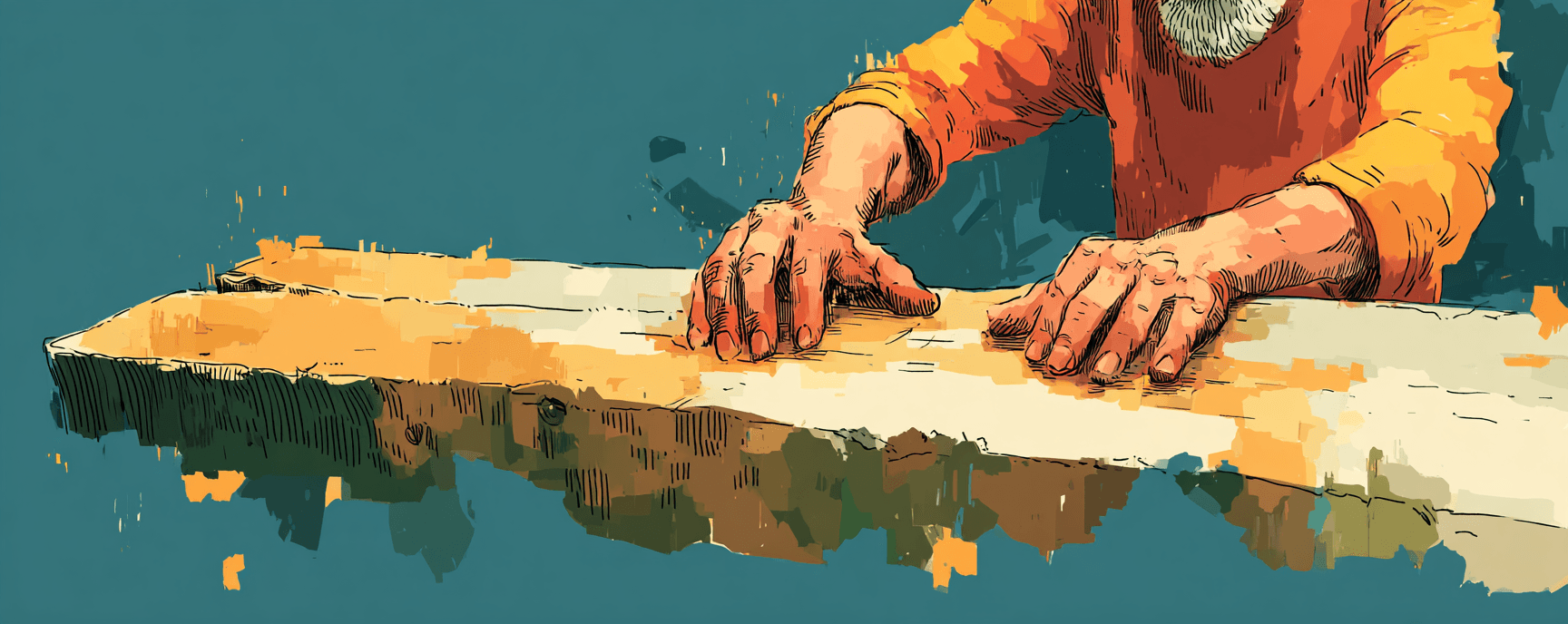
The standard response is to treat this as a change management problem. Redesign the role, give people more strategic tasks, help them adjust. But spend a minute thinking about what those three days actually contained. An analyst cross-referencing regulatory language against clinical data. Noticing when a source document didn't quite square with a submission's framing. Building, through repetition, an internal sense of what compliant work feels like, less a checklist than a kind of bodily knowledge, the way a carpenter knows a joint is tight before measuring it.
The overnight draft eliminated the production time. It also eliminated the conditions under which that sense develops.
On a process map, this looks like waste. Three days reduced to hours. But the reading was where the judgment formed; the report was just the artifact. Organizations pursuing efficiency don't have good vocabulary for this distinction, which is part of why it keeps getting optimized away. "Friction" implies something to remove. But the property being described is a design variable, something that can be tuned up or down, and the choice has consequences that outlast the quarter.
Those consequences are becoming measurable. A 2026 randomized study found that after roughly ten minutes of AI assistance, participants performed worse when the tool was removed, and many stopped trying altogether. The friction had been sustaining their willingness to engage. Separately, experienced endoscopists who worked alongside AI detection tools for months showed a measurable decline in unassisted diagnostic accuracy. These were physicians with thousands of procedures each. The act of looking carefully without algorithmic backup had been maintaining something they didn't notice until it was gone.
Aviation has a word for this, or at least a policy. The FAA explicitly encourages manual flying on a regular basis, even though autopilot is available and superior in most conditions, because the cognitive skill of managing a flight path degrades without practice. The friction is deliberately preserved. It's treated as infrastructure, kept in place because the organization decided the skill was worth the cost of maintaining it.
No equivalent exists for knowledge work. Nobody requires analysts to draft a report by hand once a quarter, or lawyers to research a brief without AI, specifically to maintain the judgment those tasks build. Part of the reason is that a plane whose pilot has lost situational awareness crashes. A compliance report that misses something subtle just ships. The degradation stays quiet, sometimes for years, until a failure surfaces that nobody can trace back to the moment the texture of the work changed.
Maybe new forms of difficulty replace the old ones and expertise migrates to wherever the remaining hard problems are. That's possible. But the EY analysts got faster, and they lost contact with the material. And contact with the material, the texture of doing the work rather than reviewing what the work produced, might be where expertise actually lives. The organizations that recognize this can still decide what to preserve. The window for that decision is shorter than most of them think.
Things to follow up on...
-
Drafting destroys ownership most: A 2026 study at the DIS conference found that AI assistance during the drafting stage produced the largest drop in psychological ownership, compared to AI help with planning or revision — suggesting that where in the workflow you insert automation matters as much as how much you insert.
-
The BCG "switching off" effect: When 758 consultants used GPT-4 on tasks beyond the model's capability frontier, those who relied on AI most heavily performed 19 percentage points worse than unassisted peers — not because the tool failed silently, but because they stopped interrogating its output.
-
Big Law's apprenticeship problem: At least one major US firm has reportedly banned junior associates from using AI so that senior partners can still assess their unassisted judgment, a rare example of an organization deliberately preserving friction for skill development.
-
84% haven't redesigned jobs: Deloitte's 2026 enterprise AI survey found that the vast majority of companies haven't restructured roles around AI, even as they deploy it — meaning the texture of work is being altered by default rather than by design.