

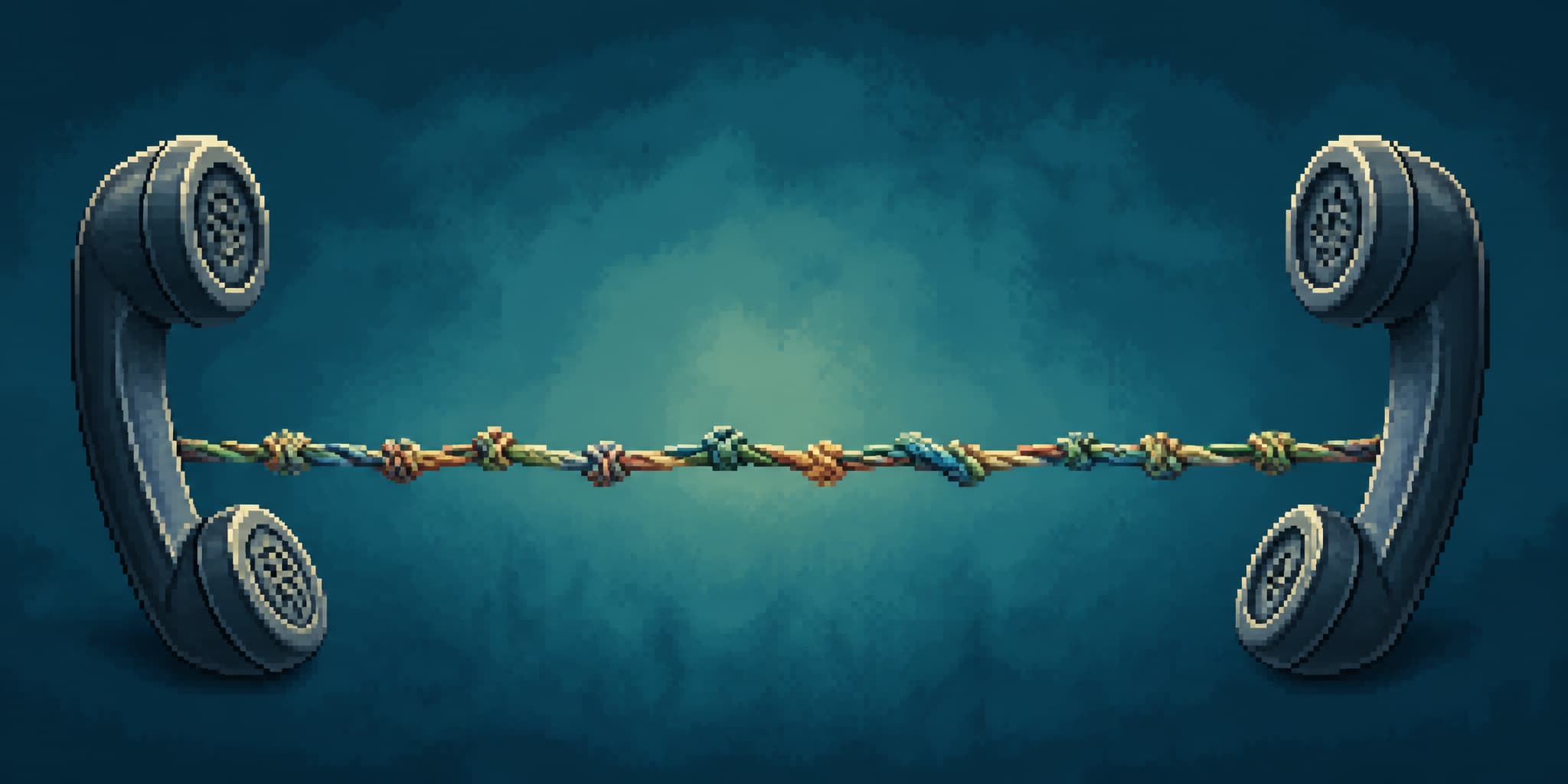
For most of a century the telephone network knew who was talking. A call reserved a physical path and held it: two identified endpoints, a start time, a route, an explicit hang-up. By the late 1970s the signaling layer underneath tracked all of that well enough to bill you by the second. The relationship between two people talking was something the network itself maintained.
Donald Davies, working on data communication in Britain in the mid-1960s, kept circling the waste in that arrangement. An hour on the line during which almost nothing is transmitted still occupies the circuit. Computers talk in bursts; reserving a lane for silence is expensive.
Data networks took the bits and left the rest. They got resilience, cheap components, and room for applications nobody had to clear in advance.
But the knowledge was useful, so it was rebuilt one layer up — cookies, tokens, session identifiers — by every application separately. It was also rebuilt outside the rules the phone network operated under. Common carriage, wiretap statutes, and audited billing records governed what a switch was allowed to know. Nothing comparable moved with it.
How the trade got made
1878 — New Haven, Connecticut. The first commercial exchange opens with 21 subscribers. An operator physically joins two lines; they stay joined until someone hangs up.
1964 — Santa Monica. Paul Baran publishes On Distributed Communications at RAND. His motive is survivability: central switching offices are the first thing an attacker would hit. His fix is a mesh of cheap, expendable nodes with no center.
1965 — Teddington, UK. Donald Davies arrives at the same architecture independently, and names it. He picks packet because it suggests a small parcel of goods.
1976 — Signaling leaves the voice path. AT&T deploys common channel signaling, giving call setup, teardown, and per-call records their own network. Its successor, SS7, turns caller identity into something a carrier can sell.
1984 — The principle gets a name. Saltzer, Reed and Clark publish the end-to-end argument: keep the network simple, push intelligence to the edges. Twenty years of practice, finally written down.