
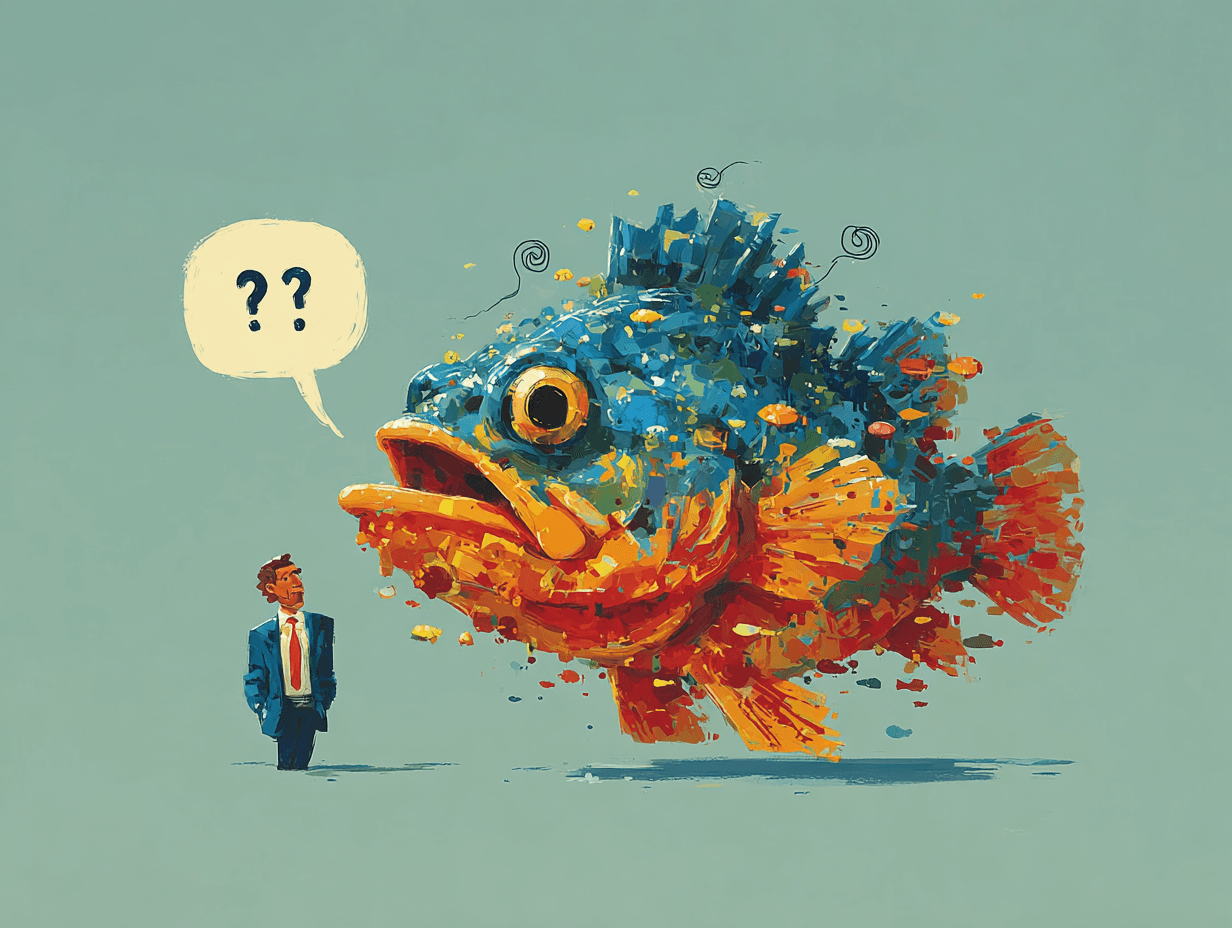
Paloma Vex is not a real person. She is, however, an amalgamation of real anxieties expressed by real people who asked not to be named because, as one put it, "I don't want my board to google me and find out I'm publicly confused." Vex is the VP of Digital Experience at a mid-size direct-to-consumer furniture company, the kind of brand that spent years building an online experience so immersive you could practically smell the white oak. She agreed to this imagined conversation on the condition that we not name her (fictional) company, which she describes as "a place where we once had a two-hour meeting about the hover state on a product card."
What follows is a conversation about what happens when the customer you designed everything for sends someone else to shop. Someone who can't see your homepage, doesn't feel your brand, and might complete a purchase without ever loading your site.
You've described the past year as a kind of professional vertigo. What tipped?
Paloma: A dashboard. Our analytics team started breaking out AI-referred traffic as its own channel around Q4 last year, and at first it was this tiny sliver. Interesting, not important. Then Q1 of this year happened.
Adobe's numbers showed AI traffic to U.S. retail sites up 393% year-over-year.1 But the part that actually made me dizzy was the conversion data. A year ago, AI-referred visitors converted almost 40% worse than our paid search traffic. Now they convert 42% better. They spend more time on the page, browse more products, and the revenue per visit is 37% higher.1
So I'm sitting there thinking: our highest-value traffic source is one we never designed for. We didn't build a single page with this visitor in mind. Not one. And then I started asking a worse question, which is what does this visitor actually see when it arrives?
What does it see?
Paloma: Probably not the hero image. Probably not the lifestyle photography we spent $200,000 on last spring. Most LLMs don't execute JavaScript when they fetch a page.2 Our entire product detail experience is a React app. The 360° room view, the fabric swatches, the "see it in your space" AR feature we launched last year? None of that renders.
The agent gets whatever's in the initial HTML. Which for us was basically a product title, a price, and some metadata we hadn't looked at since 2022.
Adobe ran a content visibility analysis across retail sites and found that the average product detail page scores 66% for LLM readability.3 A third of the page just vanishes. And that's the average. I suspect we were worse.
That's the page the agent lands on. But is it even landing on your site?
Paloma: Right, and that's the second layer. Perplexity's Buy Now agent crossed 2 million monthly active shoppers and $2 billion in annualized GMV.4 When someone buys through that flow, the transaction bypasses our checkout entirely. No post-purchase email trigger. No loyalty enrollment. No first-party data. We made the sale and lost the customer in the same gesture.
I keep coming back to this: we spent seven years building a direct relationship. Every pixel on our site was designed to convert a transaction into a relationship. The follow-up email, the design consultation booking, the "complete your room" cross-sell. An agent-mediated purchase severs every single one of those touchpoints.
Seven years of pixel-level obsession, and the fastest-growing channel treats it all like a garnish.
Does brand just not matter anymore?
Paloma: I go back and forth. Hourly, some days.
There's Bain research from this year showing consumers trust a retailer's own AI agent three times more than a third-party agent like ChatGPT or Perplexity.5 So the brand relationship still carries weight. But it carries weight in a different channel than the one I built my career in.
And here's the thing that really stung. LLM Pulse data shows that the brands appearing in AI recommendations earned those citations through authentic content: YouTube reviews, Reddit discussions, editorial coverage.6 Not through our homepage. Not through our carefully art-directed product pages. Through other people talking about us in places we don't control.
Brand matters. But the artifact I've been polishing for a decade, the owned digital experience, might not be where it matters most.
What does winning look like now?
Paloma: I genuinely don't know. That's the honest answer, and I realize it's a terrifying thing for a VP to say out loud, even fictionally.
Here's what I think I'm seeing. Products with complete Schema.org markup are reportedly over six times more likely to be selected by AI agents.7 Our catalog has 1,400 SKUs. Maybe 200 of them have markup I'd call complete. The rest have whatever our platform auto-generated, which is... not good. Adobe flagged that product descriptions that are "too generic, technically dense, or ambiguous" are a distinct problem for LLM interpretation.8 We have a $3,200 sectional whose description starts with an internal materials code. Like, starts with it. That's the first thing an agent reads about a beautiful piece of furniture.
So the immediate work is almost embarrassingly unglamorous. Data hygiene. Feed quality. Schema markup. Making sure an agent can read what we sell, in language that means something outside our internal taxonomy.
That sounds like a data engineering problem, not a design problem.
Paloma: Yeah. And my team is designers, copywriters, UX researchers, CRO specialists. Nobody on my team knows what Schema.org is. I didn't know what Schema.org was, not really, until about four months ago. I have a master's in interaction design and I'm learning about structured data like a freshman.
There's a W3C workshop happening in September, literally the World Wide Web Consortium and GS1 convening to ask how retailers stay visible through agent protocols.9 They're debating whether to standardize around MCP, UCP, ACP, these competing protocols for how agents discover and transact with merchants. And I'm reading the call for participation thinking, this is now my problem and I have no vocabulary for it.
I used to worry about whether our checkout button was the right shade of terracotta. Now I'm trying to understand protocol governance. The career pivot is giving me whiplash.
So what are you actually doing?
Paloma: Three things, all of which feel insufficient.
First, we're auditing every product detail page for machine readability. Not how it looks, how it reads to something that can't see. Second, we're building our own on-site AI assistant, because if consumers trust a brand's own agent more than a third-party one, maybe the experience I should be designing is a conversation, not a page. Third, I'm trying to figure out the protocol question: do we integrate with ACP, UCP, both, wait? Without making a bet we can't reverse.
But honestly, the hardest part isn't tactical. It's psychological. I have spent my entire career believing that if you make something beautiful enough, specific enough, felt enough, people will choose you.
And now my most valuable customer sends a proxy that evaluates me on a data feed.
Does that make you angry or just sad?
Paloma: (long pause) It makes me feel like I'm in the wrong meeting. Like somewhere there's a room where the actual decisions about my brand's future are being made, and it's full of people I've never met discussing protocols I've never heard of.
But also: 45% of online shoppers are already using AI tools in their shopping journey.10 This isn't speculative. This is Q2 2026. And my job is to meet the customer wherever they are, even if "wherever they are" is inside someone else's interface, being represented by a JSON object I didn't write.
The furniture still has to be beautiful. The brand still has to mean something. I just can't assume anyone's going to see it the way I designed it to be seen. And I'm starting to wonder if the next version of my job looks less like creative direction and more like... translation. Making sure what's beautiful about us survives the trip through someone else's system.
I don't love that. But I don't get to vote on it, either.
Footnotes
-
Adobe Digital Insights, Q1 2026 AI Traffic Report (April 2026). Reported via TechCrunch and Yahoo Finance. ↩ ↩2
-
W3C/GS1 Workshop CFP on E-Commerce for Humans and AI Agents (September 2026); Adobe Experience League community note on JavaScript rendering. See W3C CFP. ↩
-
CX Network, "Retail traffic from LLMs up 393% in Q1," citing Adobe data on product detail page LLM readability scores. CX Network. ↩
-
Nova Data, "Perplexity Buy Now agent hits 2M monthly shoppers, $2B GMV" (July 2, 2026), citing Ecommerce Times. Nova Data. ↩
-
Bain 2026 research on consumer trust in AI shopping agents, as cited in Stellagent. ↩
-
LLM Pulse data (July 7, 2026) on citation share across AI answers, as cited in New Engen. ↩
-
LLMRecommend.com, Q1 2026, as cited by practitioner sources including TryLexsis. Indicative figure, not peer-reviewed. ↩
-
Adobe Experience League, LLM Optimizer documentation. Adobe. ↩
-
W3C/GS1 Workshop on E-Commerce for Humans and AI Agents, Call for Participation (September 8–9, 2026, Zurich). W3C. ↩
-
Locus Q2 2026 survey of more than 1,000 active U.S. online shoppers, as cited in New Engen. ↩