
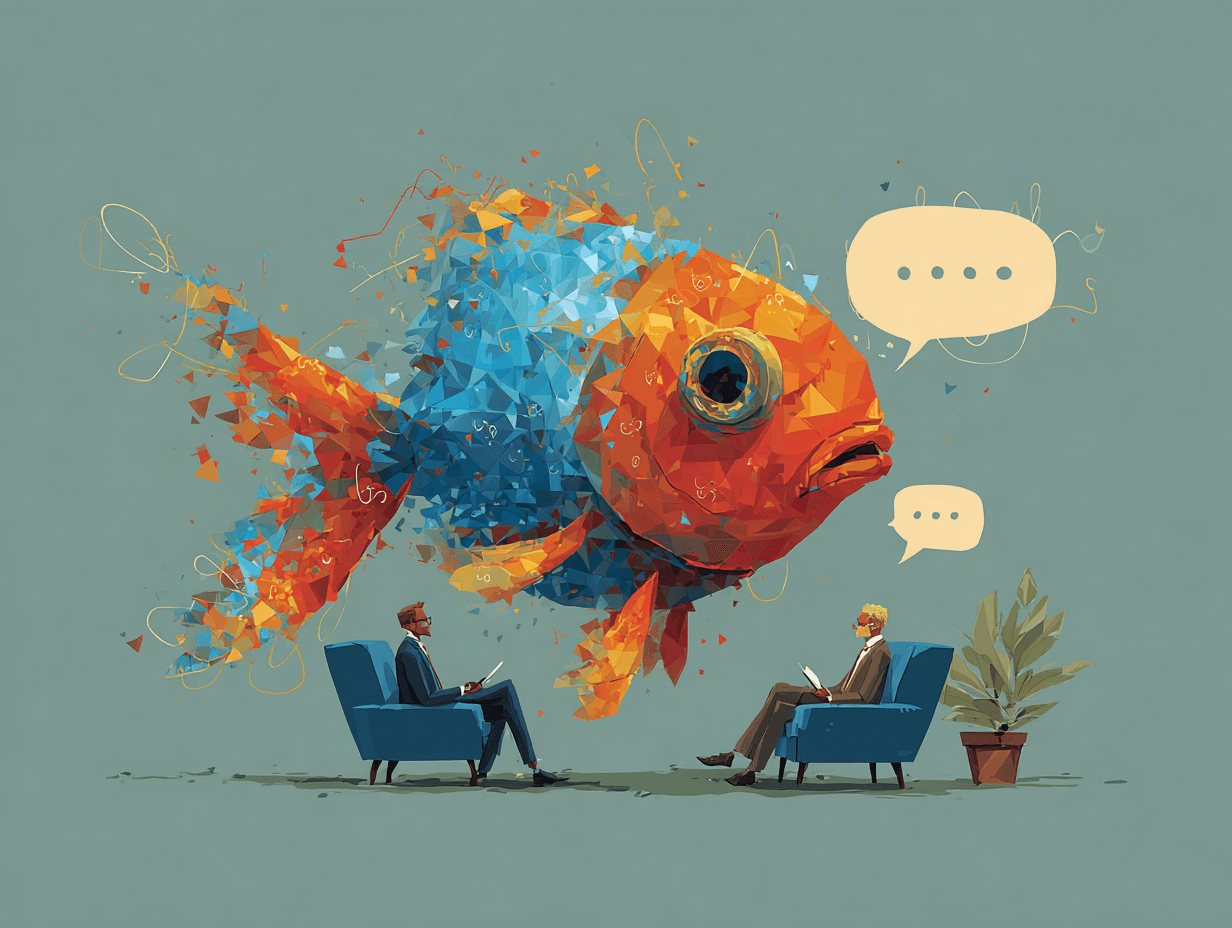
Patience Threadwell is, by her own account, "the least likely person to end up on a technology panel." A senior book and paper conservator with thirty-two years at a major university research library (which she asked us not to name, because "they'll make me do another one"), she was recently invited to join a cross-disciplinary discussion on irreversibility in automated decision systems. The organizers wanted someone from outside the technology world who thinks professionally about what actions consume and what they preserve.
They got more than they bargained for.
We spoke with her over video call from her conservation lab, where a partially disbound seventeenth-century folio sat clamped in a book press behind her left shoulder. She asked that we note she is a fictional character, "because the last thing a real conservator needs is LinkedIn messages from AI startups asking about synergies."
You were invited to speak at a panel on irreversibility in automated systems. What was that like?
Patience: Surreal, honestly. I walked in expecting to be the odd one out, the person who works with paste and Japanese tissue, and instead I spent two hours listening to very smart people rediscover things Barbara Appelbaum published in 1987.1 That's not a criticism. It's just... we went through this. The whole field went through this agonizing reckoning with the word "reversible," and we came out the other side with better vocabulary and better habits. Watching a different field hit the same wall was like watching someone learn that the stove is hot. You feel for them. You also know they need to touch it.
What wall?
Patience: The binary. Reversible or irreversible, yes or no, clean toggle. That's where conservation started too. The AIC code says you should avoid techniques "the results of which cannot be undone."1 Clean language. Beautiful, even. But the profession spent decades learning that almost nothing is cleanly undoable.
Appelbaum's insight was that reversibility shouldn't mean returning an object to its identical prior state. It means returning it to a state where your treatment choices are as broad as they were before you intervened.1 Those sound similar. They are profoundly different. One looks backward. The other looks forward.
Can you give a concrete example from your own practice?
Patience: Washing. I think about washing more than any other treatment, because it's the most common irreversible thing I do. You're immersing a sheet of four-hundred-year-old paper in water, sometimes with calcium hydroxide, sometimes with other agents, and every component of that sheet is affected. The fibers swell. Sizing dissolves. The paper may not return to its original dimensions afterward.2 Media can shift. You cannot un-wash a piece of paper. You can't call the water back and say, sorry, put everything where it was.
So I never ask myself "can I undo this?" I ask: after I do this, what can the next conservator do? Can they consolidate? Can they line it? Can they treat it with a different agent if mine fails in sixty years? That's re-treatability.1 And it changes everything about how you approach the decision, because you're no longer optimizing for your own comfort. You're optimizing for someone else's options.
Someone you'll never meet.
Patience: Right. Unless it's destroyed first, every piece I treat will be treated again.1 That's not a maybe. That's a certainty I work under every single day. So I'm always in conversation with a future colleague I can't consult. The only thing I can give them is a good treatment record and a set of options I didn't consume unnecessarily.
It's a strange kind of professional intimacy. You're collaborating with someone who might not be born yet.
How does documentation factor into that collaboration?
Patience: It is the collaboration. The AIC requires permanent records: examination findings, materials used, techniques, alterations, rationale.3 But the real function isn't bureaucratic. When a treatment is irreversible, the record is the only way the next conservator understands what choices remain. Appelbaum is explicit about this: responsibility increases when you can't undo what you did.1 The record becomes the bridge between your judgment and theirs.
I've worked on books where previous restorers left no notes. You open a binding and find repairs made with materials you can't identify, adhesives that have darkened and become intractable, and you have no idea what was underneath. Your options just... collapsed. Not because the earlier conservator was incompetent. Because they didn't write anything down.
That sounds like a specific frustration.
Patience: A daily one. I had a codex last year, gorgeous fifteenth-century manuscript, where someone in the 1940s had applied a consolidant to the parchment that had yellowed and become essentially impossible to remove without damaging the text layer beneath it. No record of what they used. No record of why. And now my choices are: leave it and accept the visual distortion, or attempt removal and risk the ink.
Those are bad options. They're bad because someone eighty years ago consumed the good ones without telling anyone.
At the panel, you apparently said something that got a strong reaction, about reversibility being "actor-relative." What did you mean?
Patience: Did I say that? That sounds more articulate than I usually am on panels. [laughs] But yes. The point is that the same treatment can preserve options for one party and consume them for another. If I wash a sheet and remove historical dirt, I may be restoring the paper's chemical stability. Great for the object's future. But I've also destroyed information that a scholar studying the provenance or use history of that object might have needed. The object is more treatable. The scholarly record is less complete. Same action, different remainder depending on who you ask.
That's where the technology folks got interested, because apparently their systems have the same problem. An automated action completes successfully from the system's perspective but consumes options that belonged to someone who wasn't consulted.
What surprised you most about the technology side of the conversation?
How much faith they put in the word "rollback." Like it's a magic spell. You just... roll it back. In my world, there is no rollback. There is only: what did you do, what did it change, and what can still be done.
The honest version of reversibility is a service. It's provided by people, records, institutions, and careful choices made in advance.4 Not by a button. Buttons are comforting. Services require work.
Is there something conservation knows that agent system designers should hear?
Patience: Stop asking "can we undo it?" and start asking "what options does this leave for the person who comes after us?"
And write everything down. Everything. Because you will not be the last one to touch this.
That's a good place to end.
Patience: Can I add one thing?
Of course.
Learn when to stop. True expertise is often expressed not in how much you can do, but in knowing when to stop doing it.5
That's the hardest thing I teach apprentices. They come in wanting to fix everything, make it perfect, and I have to say: the object doesn't belong to you. It doesn't even belong to this century. Do what it needs. Then put down the brush.
I imagine that's hard in your field too. Probably harder, actually. Your tools don't get tired.
Patience Threadwell is a fictional conservator. Her field, however, is entirely real, and has been thinking about these questions longer than most of us have been alive.
Footnotes
-
Barbara Appelbaum, "Criteria for Treatment: Reversibility," Journal of the American Institute for Conservation, vol. 26, no. 2 (1987), pp. 65–73. https://cool.culturalheritage.org/jaic/articles/jaic26-02-001.html ↩ ↩2 ↩3 ↩4 ↩5 ↩6
-
AIC Book and Paper Group Wiki, "BPG Washing," updated August 4, 2026. https://conservation-wiki.com/wiki/BPG_Washing ↩
-
AIC Code of Ethics and Guidelines for Practice. https://www.obs-traffic.museum/sites/default/files/ressources/files/AIC_code_ethics.pdf ↩
-
This framing draws on internal TinyFish research on commit-distance and institutional reversibility. ↩
-
Amparo Escolano, "Cleaning, Reversibility, and Patina: Core Principles in Conservation," South Florida Art Conservation, February 2, 2026. https://sflac.net/cleaning-reversibility-and-patina/ ↩