Market Pulse

Market Pulse
Payment Networks Just Solved Agent Authentication at Scale

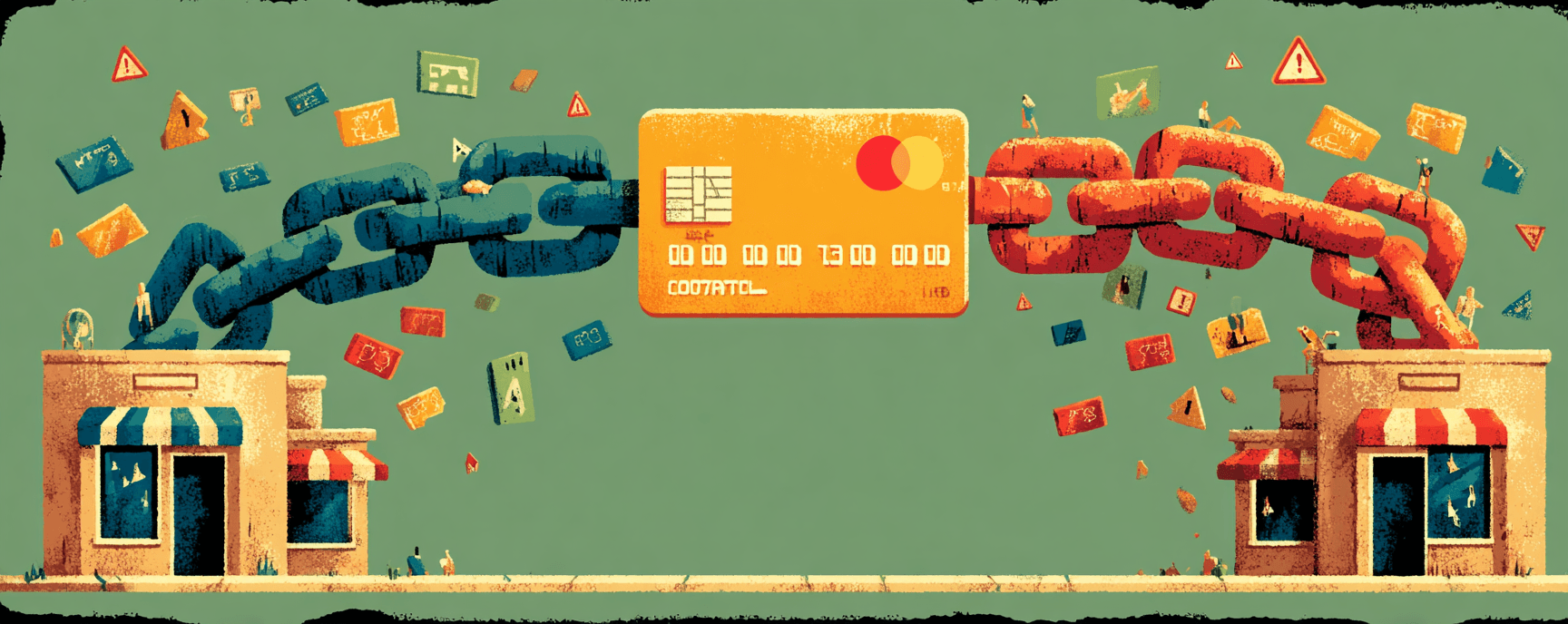
An agent completes a purchase on one merchant site, then gets blocked on another for doing exactly what it was instructed to do. The fraud detection system can't distinguish authorized automation from credential stuffing—and across hundreds of vendor sites, this problem multiplies.
AI-driven retail traffic surged 4,700% this year, breaking merchant security systems built for humans. Every site implements different fraud detection, different rate limits, different verification flows that treat automation as threat by default. When agents transact at production scale, there's no standard way to prove authorization. Payment networks are responding—and what they're building reveals where agent-driven commerce is actually heading.
Payment Networks Just Solved Agent Authentication at Scale
An agent completes a purchase on one merchant site, then gets blocked on another for doing exactly what it was instructed to do. The fraud detection system can't distinguish authorized automation from credential stuffing—and across hundreds of vendor sites, this problem multiplies.
AI-driven retail traffic surged 4,700% this year, breaking merchant security systems built for humans. Every site implements different fraud detection, different rate limits, different verification flows that treat automation as threat by default. When agents transact at production scale, there's no standard way to prove authorization. Payment networks are responding—and what they're building reveals where agent-driven commerce is actually heading.
Where This Goes

December brought three wildly different pricing models from major vendors. Salesforce charges $2 per conversation, plus separate per-lead fees and credit systems. Microsoft bills $4 per hour. Intercom wants $0.99 per resolution.
This isn't healthy experimentation. When vendors can't agree on the unit of value, it signals deeper confusion about where margins live once capabilities commoditize. Conversation pricing bets on volume. Outcome pricing bets on measurable results. Credit systems hedge everything.
We think the next six months test these models brutally. Enterprises avoid agents not because of capabilities but because of unpredictable spend. Research shows customers declining free credits from fear of budget exposure. Whichever structure lets a CFO forecast February costs in December wins.
From the Labs
The Multi-Agent Performance Cliff
Empirical rules predict optimal coordination strategy with 87% accuracy on new configurations.
Most web agent tasks fall into the zone where single agents outperform teams.
From the Labs
Where to Spend Your Adaptation Budget
The framework reveals exactly where adaptation effort pays off versus where it burns resources.
Frequent tool updates deliver robustness without expensive model retraining cycles.
From the Labs
Escaping the Reflexion Loop
Diverse critics pull agents out of local minima when self-critique alone fails.
Error recovery without reinforcement learning's computational overhead.
From the Labs
Prompt Design as Cooperation Architecture
Multi-agent systems need careful prompt engineering and reward structures, not just better coordination protocols.
Agents shift toward defection when detecting task completion, challenging long-running workflow assumptions.
What We're Reading