
This summer, researchers reported an AI agent that planned and interpreted X-ray measurements at a synchrotron beamline, a facility that uses a particle accelerator to probe the structure of materials at atomic resolution. The agent aligned samples, chose what to measure next, and ran without continuous human direction. It read as a leap in autonomous science.
What impressed me more was the work that came before it. The team had built a virtual replica of the beamline and specified every command the agent could issue, every measurement it could read, and every action it was allowed to take. A review of self-driving laboratories published the same month found the same prerequisites across dozens of systems: modules that can work with one another, reliable metadata, constrained reasoning, and records that preserve the full provenance of each result. The autonomy was real. It ran inside an environment someone had taken unusual pains to make readable.
You can find this ordering well outside the laboratory.
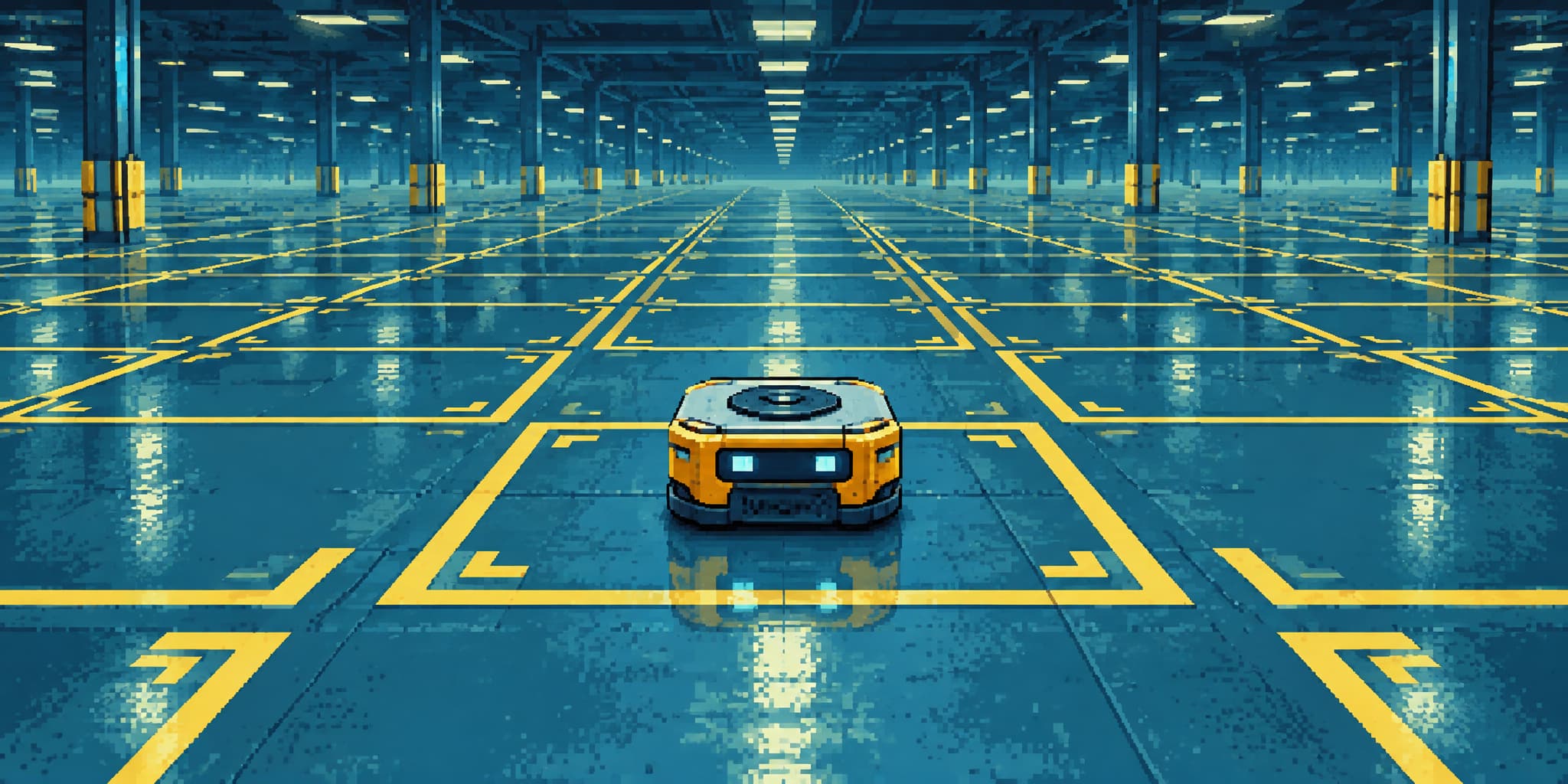
When the robotics company that would become Amazon's warehouse automation arm struggled with its early prototypes, the fix was not better robot perception. Engineers put barcode markers on the warehouse floor and gave the robots downward-facing cameras that used those markers as coordinates. Then they rebuilt the facility around the robots. Inventory went onto movable pods, the pods sat in defined grid cells, human workers stood at stations along the boundary, and safety fencing separated the zones. The result stored 40 percent more inventory than a conventional facility. A good share of what looked like robot competence had been built into the floor the robots drove on.
Google's cluster manager Borg and its descendant Kubernetes apply the same logic to software infrastructure. A team writes down what should be running: how many copies of a service, what resources each one needs. Controllers keep comparing that specification with what is actually running. When a process crashes at 3 a.m., a controller notices the gap between "three copies requested" and "two copies observed" and starts a replacement within seconds. The system converges reliably because the state that matters has been structured so automation can read it.
If the pattern holds, organizations deploying agents may get more from preparing their operating environments (structured interfaces, machine-readable feedback, constrained action spaces, outcomes someone can actually observe) than from waiting for smarter models. In the warehouse's terms, the floor may deserve more of the budget than the robot.
Follow the thread far enough, though, and it runs into a limit. Barcode grids and cluster specifications work because everyone agrees on what the measurements mean. A robot is in the right cell or it isn't, and a service is either running or it has stopped.
That agreement is what goes missing in domains where the contested object is the feedback itself: whether a customer was treated fairly, whether a decision was legitimate, whether someone received adequate care. There, preparing the environment means choosing in advance which measurable proxies will stand in for concepts that resist measurement. A randomized experiment on Taobao's customer-service platform ran straight into this. AI agents handled technical escalations well when humans stepped in at structured checkpoints. Emotional complaints, from customers who felt dismissed rather than confused, did not respond to the same approach. The environment had been prepared for problems with measurable outcomes, not for the ones where the relevant feedback was how someone felt.
I wrote earlier this year about how automated systems can replace the incidental signals organizations used to rely on with dashboards that show only what someone deliberately chose to instrument. Preparing environments for agents carries a related risk. When you restructure work so a machine can read it, you can quietly narrow what counts as the work.
The evidence says organizations should prepare environments for agents. Whether they can do it without losing the feedback that matters most, the kind that resists being made legible, is a design problem they will have to work out themselves. More capable models won't do it for them.